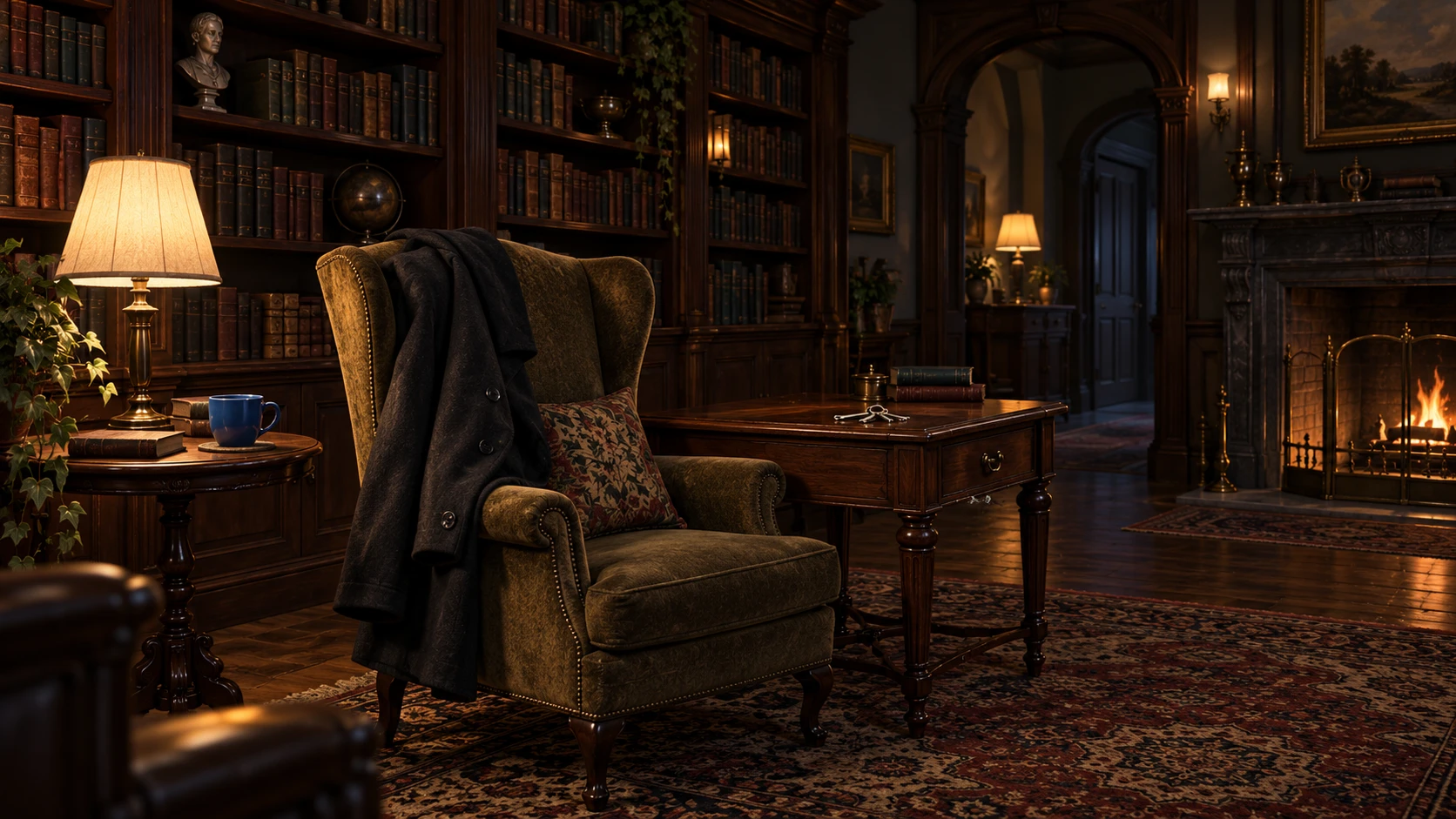
Daniel has vanished from the dinner.
A journalist disappears before his speech. His phone says he left. His belongings tell a different story.
AI narration · or read the full story below.
Blackwood House, October 17. Journalist Daniel Reed has come to a coastal-rescue fundraiser to question an old tragedy and missing fund money. He is meant to speak after dinner. Now his chair is empty.
At 9:02, his phone sent: I have left. Do not look for me. But his car is outside; his coat and keys are still in the library.
I have left. Do not look for me.
You are investigating his disappearance through collected evidence and witness accounts. Find out what happened to Daniel, and whether someone at the dinner is responsible. Begin in the library: compare the message with what he left behind.
Your first moveInspect what he left behind. Does it support the message?
The host speaks each time you open an investigation page. Skip stops only the current introduction. Read the sources, question the accounts, and use the caseboard to follow your leads.
Music starts as you enter.
No live countdown. Your progress is saved in this browser. Expanded playtest.
Extracted messages, not a phone found here. The typist is not identified.
9:11 inventory · Illustrations only; positions are not clues.
9:02 · DANIEL’S HANDSET → CLAIRE“I have left. Do not look for me.”
How should this message enter your caseboard?
Departure remains unverified.
His belongings raise questions—not proof he never left.
Choose any guest above. Their questions appear here.
No excerpts reviewed yet.
Selected excerpts from existing interviews—not a live conversation or lie detector. No need to open every topic.
“I was in the dining room from 8:30 until 9:00. I did not enter the library.”
“I was in the dining room from 8:30 until 9:00. I did not enter the library. Daniel probably left.”
What can you put to Marcus?
CASE BACKGROUND · NOT WITNESS TESTIMONY
“I did not enter the library.”
His explanation is another account—not independent proof that Daniel failed to arrive.
What does this change establish?
I did not enter the library.
The 8:42 camera record shows Marcus entering with a dark document bag. His later account admits taking his invoice folder and lying.
The apparent disappearance lead opens a financial lead.
Choose records directly. Connect the dates, then trace the recipient.
Source-built record cards—not reproductions of bank documents. All recorded facts are shown above.
Daniel’s reply: “You can return the money. That does not buy the story.”
Choose the conclusion these sources support.
The payment followed cancellation, and Marcus owned its recipient. The exchange records an offer to return money—not a completed repayment or an answer to Daniel’s disappearance.
He admitted a planned meeting. Where was Daniel supposed to go?
This payment resolves one lead. The planned meeting is a separate question.
Suggestions, not a required route. All investigation leads remain below.
Reopen a collected source, then return here. Inspecting it is not the same as proving a theory.
No sources opened yet. Start in the library and inspect an object or record.
Choose whose existing account to question. Statements are leads, not verified facts.
Stays in this browser. No account, submission or tracking. Your theory never blocks exploration.
No findings recorded yet. Your working suspect is not a verdict.
Follow the open leads first. Final reconstruction unlocks only after the required investigations.
Clears only the expanded-build progress and notes in this browser. The compact demo is untouched.
Unseen HorrorsKevin MacLeod
Music starts when you enter the scene.
Unseen Horrors — Kevin MacLeod (incompetech.com)Licensed under Creative Commons Attribution 4.0.Normalized, transcoded and faded for this looping soundtrack.
Daniel’s green scarf.Crossing the courtyard.
Six minutes fast.
The cameras keep correct time.
Choose a timestamp.
A scarf is not an identity.
“At 8:50 on the kitchen clock I saw someone in Daniel’s green scarf crossing the courtyard. Only their back. Claire finished the place cards at 8:56. At 9:05 I asked everyone to search.”
Witness account—not a verified identity.
“The kitchen wall clock runs six minutes fast. The cameras use correct house-server time.”
No camera continuously covers the library interior.
A frozen expanded development playtest adapted from The Missing Guest free demo, observed 25 October 2026. The live game and existing purchases are unchanged.
The moving scene is an animated game illustration, not recovered footage or an actor performance. Decorative architecture, lighting and clothing shapes are not extra clues. Required evidence is captioned; no sound is needed to solve this scene.
Optional music is Unseen Horrors by Kevin MacLeod (incompetech.com), ISRC USUAN1400043, under Creative Commons Attribution 4.0. It has been normalized, transcoded and faded, and is looped at your chosen volume. Full source and license links are in Music settings. Music starts when you enter the scene, unless you mute it. The on-scene Mute button stops it immediately; Volume opens the soundtrack controls. Your mute choice is remembered in this browser tab for this visit. Music pauses in a hidden tab and resumes on return only if you have not muted it; browser restrictions may require Play again. It is not a witness recording. No microphone is used. Expanded-build progress and optional notes are saved locally in this browser when storage is available. No microphone, remote account or tracking is used.
After dessert. Every letter is one place too far ahead.
Recovered beneath Daniel’s speech notes. The note is addressed to Elena.
CPBUIPVTF
Decoded destination: BOATHOUSE
A planned destination is not a recorded arrival. Compare the vehicle timings with the route.
An intended destination. Not an arrival.
Keep the plan separate from what the records show.
Reconstruct the collected records—not a search of anyone’s belongings.
Select an object, then a person. Dragging works too.
The original was not lost.
Their authenticated exchange shows the split was deliberate. The records support an effort to keep the original out of her reach, not every reason for it. That does not verify everything Elena says, or prove where Daniel went afterward.
Witness claims, not an additional verified record.
The initial record does not identify the object.
Select a detail to inspect.
Recorded label 03 / Lighthouse
Recovered by patrol—not a new player search.
Tap a marked detail in each image, then link them. Text controls do the same thing.
Verified exterior record · 8:51–9:07Only Marcus enters or leaves the wagon.
Daniel’s location is still unknown.
What made you suspect him, if you did? Which record changed that suspicion?
8:54. Marcus loads a pale, covered shape through the rear door of his green rental wagon.
8:55. The wagon leaves along the service road.
9:07. The wagon returns.
The initial frame does not resolve the covered object. Nobody’s face is visible inside it. The other guests’ vehicles do not move.
The enlarged courtyard frame resolves straight edges, packing tape, and a label: 03 / Lighthouse.
Dispatch at 9:05 sends one patrol to follow the wagon’s service-road route. At 9:17 that patrol records a wrapped exhibition frame with that label in the boathouse. Continuous exterior footage shows Marcus as the only person entering or leaving the wagon from 8:51 to 9:07.
Game illustrations reconstruct the supplied records. The initial review and original-resolution source are separate evidence views—not AI enhancement or recovered video. Appearance, architecture and lighting are decorative, not additional clues. The 9:17 recovery is an existing patrol record, not a live search triggered by the player.
Mara died during the 2014 storm.
Exhibition print · central crop
Compare Daniel’s published account with the inquiry statement, work order and job sheet. Which record supplied the claim? What independently checks it?
“The escape gate remained open throughout the evening.”
Drag a record onto the claim—or tap it, then place.
He came to expose a cover-up he had helped make believable.
His old article repeated a claim the full photograph contradicts. His saved correction existed before he disappeared. The correction does not undo the old reporting; it changes what his return tonight means.
The original contradicts that account—not proof of who caused tonight’s disappearance.
2015 · Claire’s exhibition instruction: “Use the central view. Remove service clutter from the left edge.”
8:20 · Daniel → Elena, authenticated pre-dinner exchange: “You keep the original in the battery case. I will carry the empty sleeve. She must not know.”
The original negative remains with Elena. The exhibition print shows the center of her photograph of the pier. Daniel’s notes ask for Marcus’s old insurance file.
The unaltered full frame shows the pier emergency exit chained at 9:11 on the night Mara died. The chain is outside the exhibition crop.
6:10 · Work order signed Claire Blackwood: “Keep pier escape gate chained until donors leave.”
Theo’s signed job sheet: installed 6:35; removed 10:20, after the rescue attempt. Staffing sheet: Mara assigned to retrieve lighting equipment from the pier.
Claire’s signed inquiry statement: “The escape gate remained open throughout the evening.”
Daniel’s 2014 article repeats that statement. His draft correction, saved before dinner tonight, acknowledges that he printed it without checking the gate.
The crop and full view use the same game illustration, masked in the interface. This is not the actual photograph, generated missing evidence, or AI enhancement. The verified written record supplies the gate’s identity, time and condition; incidental scenery and hardware are not extra clues.
Select a marker, then tap a place. Change the time to make a separate proposal. Daniel can stay unplaced.
Select a marker, then tap a place. Arrow keys move the selected marker between places. Both markers stay editable.
A3: the library reaches archive storage through its corridor, without crossing the courtyard. The boathouse is across the courtyard and service road. Diagram distances and incidental scenery are not evidence.
The movement between the 8:50 reading and the 8:57 association is not recorded. The 8:57–9:03 archive-zone association is recorded. No measured route is shown.
The archive access point covers neither library nor boathouse.
The association follows Daniel’s handset, not his body or the person using it. It does not distinguish archive room from corridor. The movement after 8:50 and before 8:57 is unobserved.
An extracted message, not a handset found on the library table. It does not identify the typist.
Build the comparison from source records. The journal records a lock state—not who turned the key.
Sole working crescent key · no duplicate or damage.
One door · no usable window · no inside release.
Claire wears the key in both recorded appearances.
Choose whose opportunity to test.
A gap. The key. Supported opportunity.
Claire fits both. The record does not film her turning the lock.
Entry log: no further guests or contractors after 8:30. Police enter at 9:08.
Collected camera records and sealed-sample results. Illustrations are diagrams, not footage.
Inspect a record, then connect it to a question.
The handling and the samples connect.
Dose unknown. No continuous library-interior recording. Keep these limits in your reconstruction.
I can still put this right.
“What sleeve? Where is Daniel?”
Police opening: 9:14:08. Editor’s copy: no empty-sleeve reference.
Tap passages to keep—or use the whole exchange.
Build the connections. Test one alternative.
Tap to inspect. Drag to connect.
Daniel is alive.
Daniel is alive. That answers the most urgent question, not every one.
Marcus’s payment still happened. The cropped photograph still concealed the chained gate. Daniel’s article still repeated the false account, and his correction still needs to confront it.
Elena kept the original out of reach. Now the uncropped image can be read beside the words it contradicts.
The case is not one secret belonging to one bad person. It is several people’s choices, and the records that let you separate them.
END OF THIS EXPANDED PLAYTEST
Expanded development playtest. The one-hour design target has not been validated by first-time players.
Fit a possible stop between the wagon’s recorded exit and return.
TEST PROPOSAL
A road-time model, not proof of a visit.
His presence is not established by wagon timings.
MODEL: the same four-minute road route each way. These are not observed arrival or departure times.
The note plans a meeting with Elena. Marcus separately claims an invitation and a no-show.
“After dessert.”
MARCUS · COLLECTED ACCOUNT“Daniel asked me to meet him after dessert. He never showed.”
A plan and an account—not a verified arrival.
Choose what to question. This return interview is optional.
An existing recorded interview excerpt—not a new live confession.
Separate what the records establish from his explanation.
Select a fragment, then a lane.
Tap a route to shore. Then test the gate.
A lower landing. No onward shore walk.
The side return rejoins before the gate.
C3 · 2014, 9:11 · The emergency exit is chained.
Documented connections. Apply the gate condition separately.
Proposed insurer-held 2014 survey copy and companion inspection views. They describe structure, not the storm-night events. Both come from the same survey packet.
These are new authored additions for this optional story experiment—not records present in the published case.
The test point is not Mara’s known position. This cannot establish what she tried, whether a route was safe, or whether she would have survived. It does not rule out climbing, swimming or boat rescue.